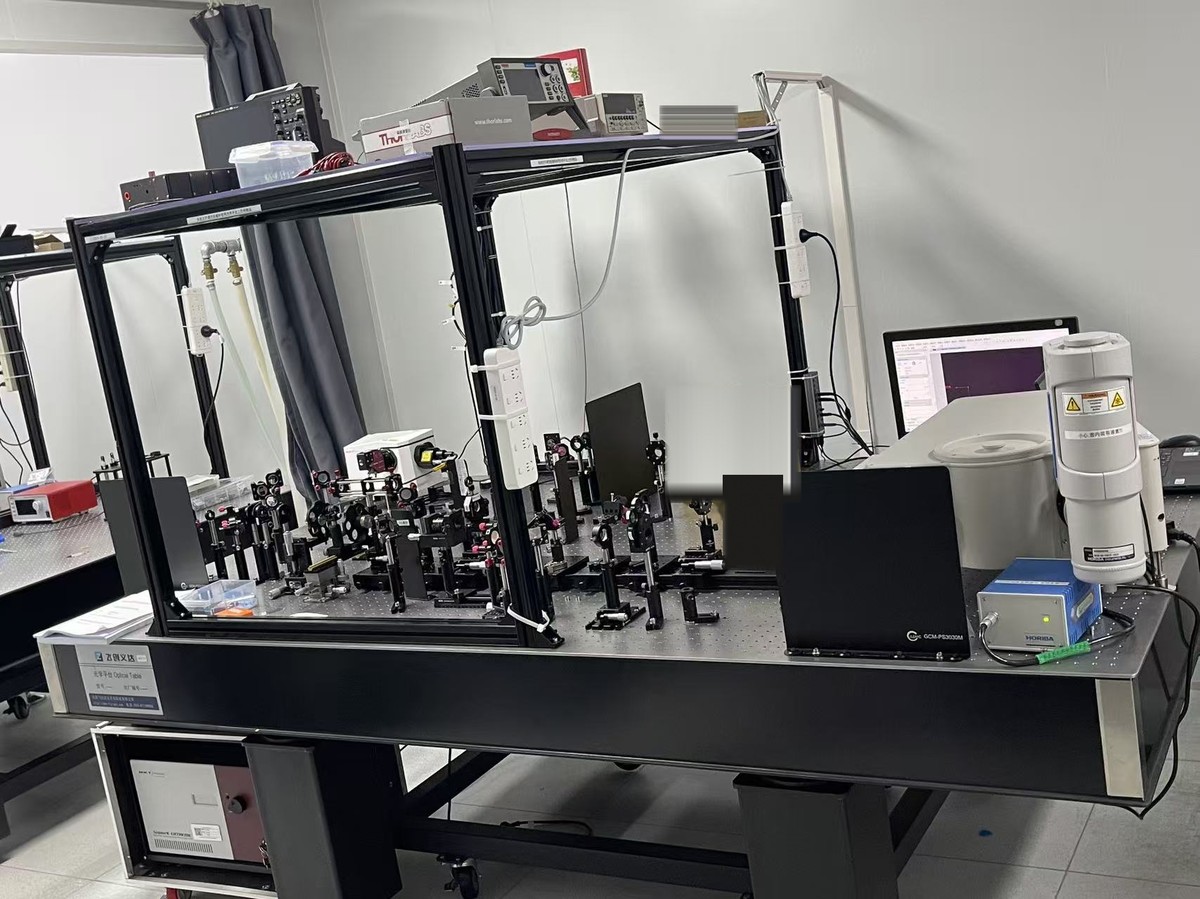
Angle-Resolved Spectroscopy System
Type: In-house transmission and reflection angle-resolved optical paths coupled to a HORIBA iHR550 imaging spectrometer
Location: Cleanroom, Building M
Technical Specifications:
- Light sources: supercontinuum laser 260–2400 nm with a 400–1000 nm tunable band-pass filter; white-light LED and halogen lamp
- Detection: HORIBA iHR550 imaging spectrometer and a CMOS camera
- Polarisation: Glan–Taylor polariser and analyser (extinction ratio 105:1) with super-achromatic wave plates
- Objective: 50× (NA 0.50 / 0.35), which sets the accessible in-plane wavevector range
Measurement principle:
The objective maps every propagation direction onto a position in its back focal plane (Fourier plane), whose radius corresponds to the in-plane wavevector k∥. Imaging that plane onto the spectrometer slit and dispersing it with the grating makes the two detector axes correspond to momentum and wavelength, giving an E–k∥ map in a single exposure without angular scanning.
Main Functions:
- Angle-resolved reflection / transmission spectroscopy: direct read-out of dispersion, band structure and band gaps
- Angle-resolved photoluminescence: intensity versus wavelength and angle, revealing directional emission, angular spread and polarisation
- Isofrequency imaging: full Fourier-plane imaging under narrow-band illumination gives the 2D momentum distribution at a fixed frequency
- Polarisation-resolved angular spectra: Stokes parameters and momentum-space polarisation topology (e.g. polarisation vortices and topological charges at BICs)
- Applications: momentum-space characterisation of BIC / q-BIC and exceptional points, exciton-polariton dispersion and Rabi splitting, directional emission control